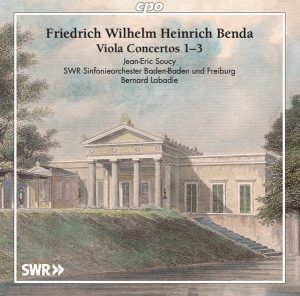
For years, in fact ever since I played the concerto in F major attributed to Georg Benda, I have been trying to get hold of the other two concertos written by this composer. References to these works appear in Franz Zeyringer’s book “Literatur für Viola” (ed. 1985). We can read that there are 3 concertos for viola with a large orchestra (18th century). One in F Major published by Schott, another also in F Major and finally one in E-flat Major. Referenced in the Prussian Cultural Heritage section of the national library of Berlin (Staatsbibliothek zu Berlin, Preussischer Kulturbesitz) in the form of manuscripts.
I went to the library and did not find any of the concertos under the name of Georg Benda. There is, however, a copyist’s manuscript of the concerto in F major “attributed” to Georg Benda. On the other hand, under the name of his nephew Friedrich-Wilhelm-Heinrich, there are indeed two concertos in E flat major. Are these the two untraceable concertos attributed to Georg? Everything points to this. The New Grove Dictionary of Music clearly states that three concertos are attributed to Georg and three are composed by Friedrich: in my opinion they are the same. The same goes for the MGG (Musik in Geschichte und Gegenwart).
It must be said that keeping track of the Bendas is not easy: there are two Georgs, three Friedrichs, two Heinrichs… In short, this family came from Bohemia in 1742 at the behest of Frederick the Great, King of Prussia, and remained attached to the court for about a hundred years.
The Benda family played a significant role in the history of German classical music. The patriarch, Jan Jiri, had two sons who would also become musicians at the Prussian court, Franz and Georg Anton, while a third son ended up at the court of Dresden. In addition to the sons, there were daughters, singers, who took part in the various productions of the court in Weimar, Dresden, Leipzig and Potsdam. The Bendas, led by Franz and Georg Anton, were part of the “Berlin School” along with the composers Quantz and C. P. E. Bach. The dramatic form of Georg’s operas greatly influenced Mozart. The Bendas’ music was as popular as that of Haydn or Mozart at the time, which says it all.
The Benda in question here is Friedrich Wilhelm Heinrich, born in 1745 and died in 1814, son of Franz and nephew of Georg. He wrote operas, secular cantatas and oratorios. But he is best known as a composer of instrumental music, of concertos for various instruments. His talents as an accomplished violinist and violist also made him very popular as a performer. The virtuoso passages of the three concertos he wrote for the viola prove beyond doubt that he had mastered the technique of this instrument to perfection.
Freidrich Wilhelm Heinrich Benda was born on July 15, 1745 in Potsdam and was baptized at St. Petrikirche church on July 20. The king, two princes, the queen and the queen mother, all represented by nobles and members of the court, acted as godparents to the first son of Franz Benda, concertmaster of the Royal Orchestra.
He studied the violin with his father and learned music theory with Johann Philipp Kirnberger, himself a great admirer of Bach, whose works he studied extensively.
In 1782, at the age of twenty, he joined the Prussian court orchestra and became the leader of the second violins. At the same time, he worked as an organist, pianist and composer, as well as teaching music theory. He was married twice and had four children.
Benda retired around 1806-07 and was unable to continue teaching due to deafness. He then received a half pension from the state. His brother Carl helped him financially and asked the king to continue if he ever died before him.
Friedrich died of a nervous breakdown at the age of 68 (NervenAnschlag) in 1814.
From: The life of Wilhelm Friedrich Heinrich Benda (Franz Lorenz- “Franz Benda und seine Nachkommen” Band 1, ed. De Gruyter 2015)
There is a theory that Friedrich-Wilhelm appropriated the first two concertos that his uncle Franz-Georg is said to have written. I do not agree with this idea put forward by Ulrich Drüner (Das Viola Konzerte vor 1840 – Fontes artis Musicae 28, Kassel u.a. 1981, p.153)
If we compare the two concertos in E flat major with the one published in F major, many of the sixteenth-note motifs in the solo part are surprisingly similar. The slow movements also show a disturbing similarity in the harmonic progressions. The overall construction therefore leads me to believe that the three concertos are by Friedrich and not by Georg. It should not be forgotten that Friedrich Wilhelm Heinrich and his uncle Georg were almost twenty-five years apart, hence a certain “modernity” in Friedrich’s writing compared to Georg’s, and that even though the latter was also a violinist and violist, he devoted most of his life to lyrical works: operas, cantatas and oratorios.
It is rather difficult to assign an order in which the concertos came into being, but I will take the “risk” of doing so based on the following observations:
- The F major, in my opinion, is the first, because of the typical writing of the basso continuo and its galant style. It would have been written before 1775. The musicologist Phillip Schmidt provides arguments supporting my assumption in the preface of the concerto in F major, composed by Karl, Friedrich’s brother, and edited by Schmidt. (See annotation 16 of the preface)
- The first Eb maj. 1778 or earlier, I wonder if it is not even later.
- Harmonic simplicity. Lyrical voice accompanied by vertical chords. Almost total abandonment of basso continuo. Emphasis on virtuosity; the music is written for soloists.
- For the third concerto, it is easier to assume the date as being between 1790 and 1800 because of the paper. On the paper used, we can see a watermark (a crowned eagle with a sceptre and a sword), which comes from a paper mill called Wolfswinkel that existed between 1790 and 1803.
These concertos are in any case magnificent additions to the repertoire of my instrument. They are every bit as good as the Stamitz and other Hofmeisters, on the contrary… I hope that viola players and listeners will find it as much pleasure to discover them as I have had in working on them.
I would like to thank the following people, without whom this publishing work could not have been done:
- Sonia Simard, pianist, who not only produced the orchestral reduction for piano but also participated in all stages of the research and the editing itself.
- The Prussian Cultural Heritage Section of the Berlin National Library, who were very kind and equally competent, with the exception of its director, who clearly refuses to understand the importance of the use of original scores for performers, the very people who bring the scores entrusted to them to life.
- The musicians of the SWR Sinfonieorchester Baden-Baden-Freiburg and conductor Bernard Labadie, who, thanks to their incredible knowledge of the classical repertoire and its style, helped me to discover and record the concertos under the best conditions that an interpreter could dream of.
- The musicologist Phillip Schmidt of Leipzig, who patiently shared his knowledge to help me understand the many pitfalls of library research that constantly confront the amateur that I am…
- And finally, thanks to Mihoko Kimura of Edition Offenburg, who, thanks to her probity, the quality of her editing and her sense of risk, offers a royal gift to all viola players