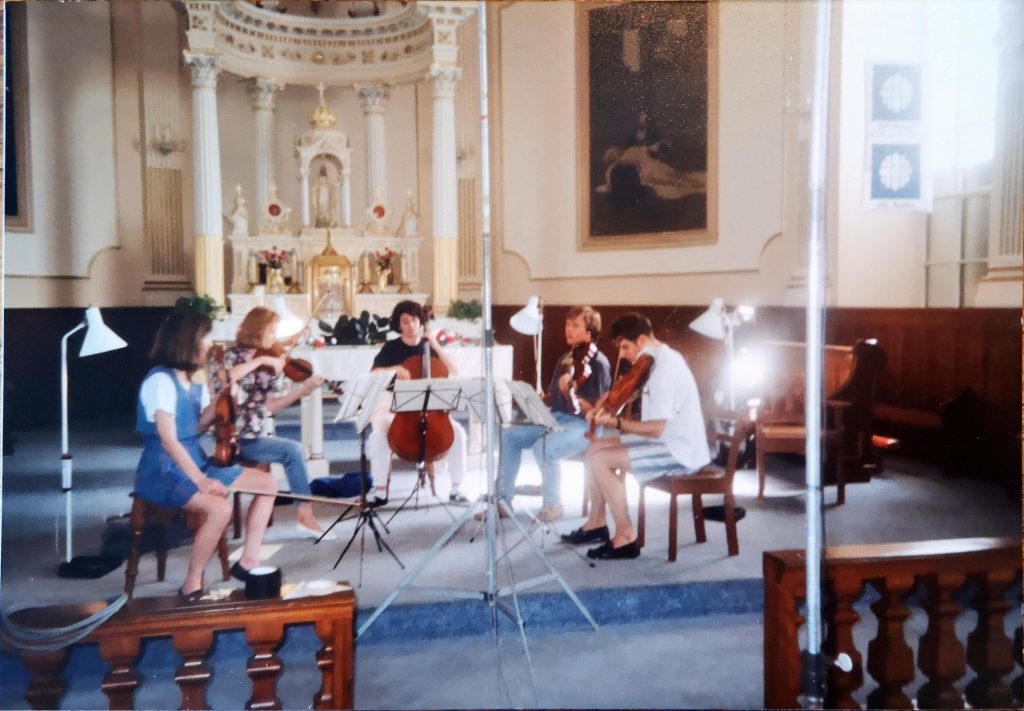
The fall of 1986 marked my return to Quebec after a fruitful year of study in Vienna. I joined the Quebec Symphony Orchestra as principal viola and returned to play in Les Violons du Roy in the same position. Les VduR grew in importance and soon the need arose to form a string quartet from this small group. Raising the level of the group requires greater cohesion among its main members. Learning the quartet repertoire is an integral part of training string instrumentalists. Moreover, with a string quartet as the core, an infinite number of combinations open up to us to broaden our repertoire even further.
Very early on (1987), we sought to satisfy the need to deepen our learning of the difficult art of the quartet. I therefore called upon the master teacher Hatto Beyerle, violist and founder of the Alban Berg Quartet. Having maintained an excellent relationship with him after studying in his class in Vienna, I invited him to spend a few weeks in Quebec. On the program: quartet coaching and learning Brahms’s quintet for two violas (Op. 111 No. 2). Two concerts were planned: one in the ProMusica series in Montreal and the other in the VduR series in Quebec City. And to help finance Hatto’s visit, I suggested organizing a workshop for Quebec quartets at the Domaine Forget. François Bernier will call this event “Easter for Quartets.” Finally, five quartets will join us for a four-day mini-workshop. Radio-Canada will record the workshops and the final recital.
In three weeks and thanks to these meetings, our quartet made more progress than in a whole year. One thing is clear: we need to rub shoulders with other musicians from other horizons who are ready to share their love of chamber music with us. Hence the idea of creating a festival that brings musicians together around their ideal of the pleasure of sharing a passion for the chamber music repertoire. The idea of the Rendez-vous musical was born.
In the fall of 1989, I had a fairly precise idea of the form our festival could take. A venue was missing. I wanted to get away from the cities of Quebec and Montreal, as well as from the main summer music venues of Orford, Domaine Forget and others Lanaudière. The choice of my native region seems to me as natural as it is logical. There is no classical music festival in Chicoutimi and its surroundings, although traditionally a clientele of amateurs regularly attend classical music activities and concerts during the school year.
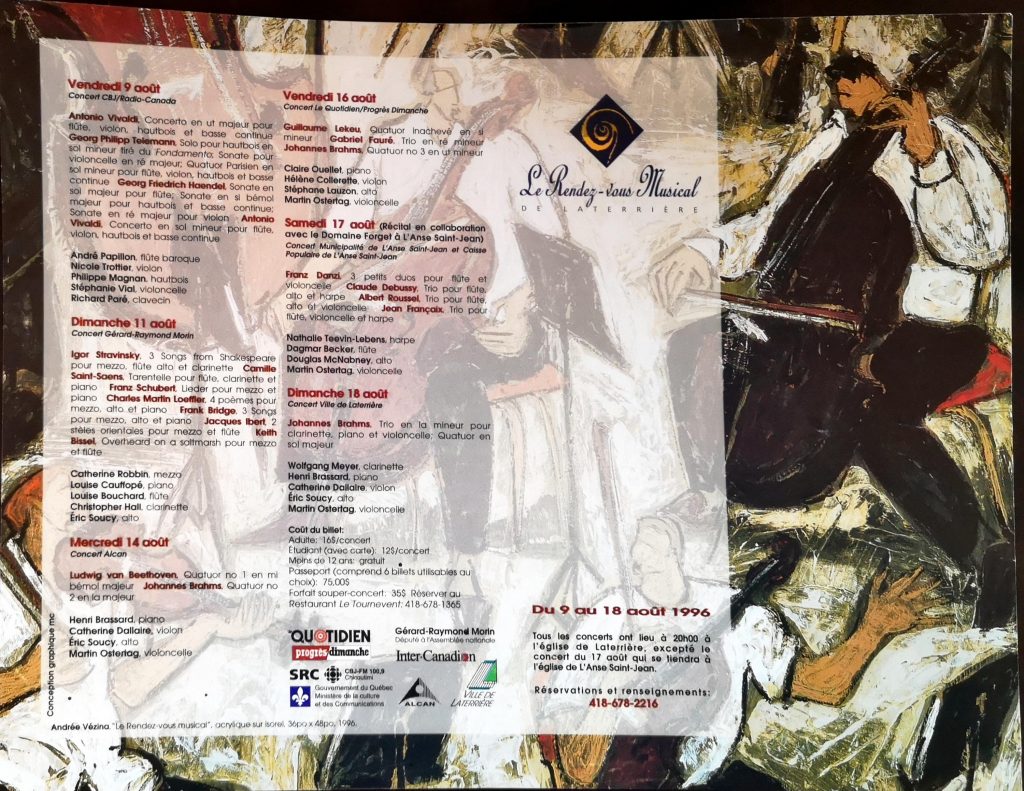
Five recitals over a ten-day period with concerts on Fridays and Sundays and one on Wednesdays. The quartet is the skeleton to which accomplished musicians from different backgrounds are added, mainly from North America and Europe. This naturally includes musicians from Quebec and Saguenay-Lac-Saint-Jean.
All that is missing is the venue.
Talking with friends from the Saguenay, a place and a team come to mind: the equestrian farm and its restaurant, Le Tournevent. Around Jeannot Tremblay, his brother Alyre and Louise O’Doherty (see personal archives), a place full of charm and poetry has been created. They are people who are sensitive to the arts, receptive and daring. They are ready to embark on the adventure, even if I sense a certain skepticism and fear linked to the precarious financial situation of their business. We will perform right in the riding arena, which will be magnificently converted into a concert hall by Alyre, with the added bonus of the smell of horses.
From the second edition onwards, we will settle permanently in the village’s century-old church. All the while continuing to work with Louise’s restaurant and the inn integrated into the equestrian center.
So in 13 editions, from 1990 to 2002, there will have been 64 recitals bringing together more than 350 musicians, singers, actors, reciters, and even a few horses! The numbers are always a bit mind-numbing. But beyond the statistics, it is remarkable that each and every one of these recitals was recorded and broadcast on Radio-Canada. These recordings were then broadcast on European French-language channels (France, Belgium, Swiss, Luxemburg) as well as in Austria and Sweden. The special programming and the quality of the musicians brought together are largely responsible for this, but also, and I must emphasize this, the director at the time at Radio-Canada CBJ, Jean-Marc Gagnon, who contributed greatly to this achievement. His conviction and deep commitment made him a staunch defender of our festival.
Any examples of originality? Marc-André Hamelin brought us the piano quartet of Thuille, a composer whose reputation he helped to revive. Enescu and his formidable quintet with piano was also one of the discoveries. It was at Laterrière that Korngold’s sextet for strings was performed for the first time in North America after the composer’s death. It has since become a standard in chamber music literature.
A great moment at the Rendez-vous was a magnificent interpretation of Schubert’s “Gesang der Geister über dem Wasser”. Bernard Labadie was joined by inspired singers and instrumentalists… what incredible luck!
Among other memorable events, a recital entitled “Round Midnight” lasted over 4 hours, with staging and a narrator. The theme of the night was a succession of pieces including Beethoven (Moonlight Sonata), Schönberg (Verklärte Nacht) and culminating in Thelonius Monk (Round Midnight). Staged and with texts chosen by Serge Denoncourt, texts recited by Monique Miller.
In conclusion, we must emphasize the contribution of the municipality of Laterrière and its services. They have kept the Rendez-vous musical going for years. The equestrian center that hosted us the first year, having encountered significant financial setbacks, was unable to continue its involvement as we would have liked. However, the municipality and its mayors, deputies, firefighters, municipal employees… in short, the whole town has taken up the torch. In addition to these key players, there were of course the many members of the board of directors that the Rendez-vous has known. And its successive presidents, who ALL played an essential role in the existence of what was basically a slightly crazy project. This extraordinary collaboration lasted until the merger of the municipalities in 2001, with the disastrous consequences that this political decision had on culture from 2003 onwards. The role played by the then new mayor, Jean Tremblay, was that of a damper, a gravedigger of the performing arts in the region. His own cultural ignorance, which he boasted about, being the yardstick for his devastating inaction.
During my last board meeting, I experienced a completely surreal moment. It was a typical stormy day in March. I was about to present the program for summer 2003. The then chairman of the board, former mayor of the city and new spokesman for the Tremblay administration, said something like: “We don’t think it’s local enough. It’s money that comes out of our pockets, it has to go back in our pockets!” I pointed out to him that regional artists were present in all the editions of the Rendez-vous. What’s more, we serve as a showcase for the region since the reruns of the recitals went well beyond the Canadian borders. And a showcase, I might add, is a two-way street: we are seen, but we also take a look at others, the rest of the world, which in art (but not only) is absolutely essential. Then he replied: we don’t want a showcase; we prefer a mirror!
For me, that was the final straw. And also an enlightening explanation of the reasons for the obscurantism of the regional authorities. Too much for me. And in the end, 13 editions is not bad…
Since then, the Rendez-vous musical has been reborn. First through the efforts of Pauline Morrier and her daughter Renée-Paule Gauthier, and then taken over by David Ellis, the cellist of the regional string quartet. The name has always belonged to the non-profit organization that presided over the festival’s inception and which is still in existence. There can never be too much chamber music and musicians who share it. Although a little sensitivity towards those who created the event would have been appreciated, in my opinion it is more important that the music continues to be shared, in Laterrière as elsewhere. Long live the Rendez-vous!!