
I like to focus on giving a profound and genuine meaning to the music making. Have a look at what connects the different styles and epochs—the many ways of giving back to the listeners our own understanding of the music we play.
I was a teacher for many years at “Le Conservatoire de musique du Québec” during my time as a solo-violist with the Orchestre symphonique de Québec (1986–1991).
I was also teacher in the “Musikhochschule Karlsruhe”, from 1996 to 2003. After that, I chosed to concentrate on my solo, chamber music and orchestra carreer, and to be honest, have some more time for my family life…
But I love teaching, so on a less regular basis, I visit schools and other venues for Masterclasses since 1986 until now. Most of them, many years in a row: in Belgium(Accademie in Brugge), France (Haute Ecole de Musique Strasbourg), Brazil (UERJ Rio de Janeiro), Canada (SOAP in British Columbia, Toronto in the Glenn-Gould Music School, Domaine Forget, the Orford Academy), Switzerland (Basel, Neufchatel), Austria (Viola Symposium Feldkirch), Australia (Melbourne, Brisbane, and Adelaide universities as well as Sydney’s conservatorium),Greece (MAASK), Germany ( Dortmund Orchester Zentrum NRW).
Of course, working on your technical skills is a must. But playing chamber music with other musicians, better as oneself if possible, and as much as you can is the key to success.
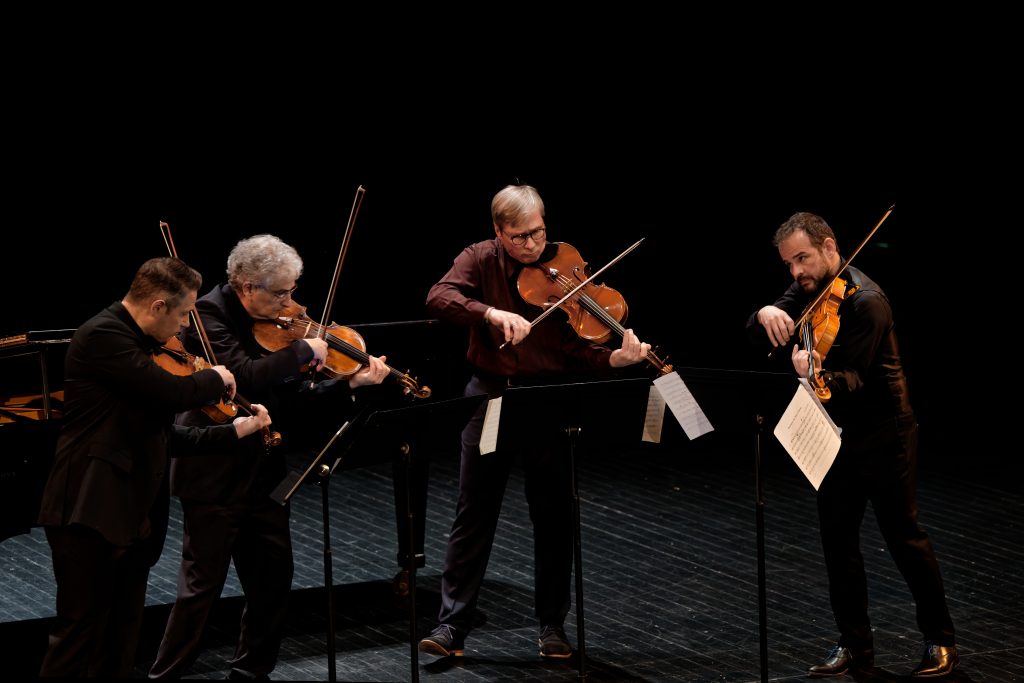
The role of the viola in chamber music and in orchestras is to be the glue, the passing player, the coordinator, and the peacemaker all at once! Aside from that, if you’ve ever played a Mahler symphony because in his music it’s so typical, you remember how often the changing of color, chords, through a unique note is given to the violas? The blue note… my love
I’m often asked which qualities are for me the most important in a viola player? Flexibility! And a profound knowledge of the score, whatever you play.
Get in Touch
Get in Touch with Jean-Éric Soucy, the Renowned Violist